
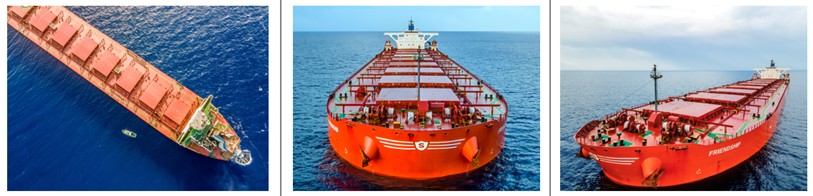
 Safe Bulkers (NYSE: SB) closed 2025 with a disciplined balance sheet, steady shareholder returns and a clear fleet renewal strategy centered on Phase 3 tonnage, positioning the company to benefit from a volatile dry bulk market, navigate challenges effectively, while capturing opportunities, reaffirming its commitment to operational excellence and sustainable growth.
The Q4 2025 earnings press release can be accessed here
The Q4 2025 earnings presentation can be accessed here
Fourth quarter net revenues reached $72.6 million, up 2% from $71.5 million in the same period of 2024. For the full year, net revenues totaled $275.7 million compared with $307.6 million in 2024. Net income for the fourth quarter was $11.8 million, down from $19.4 million a year earlier. Adjusted net income for the quarter was $15.9 million, translating into adjusted earnings per share of $0.14.
Results reflected a slightly improved charter market compared with the same period in 2024, with higher charter hires and incremental earnings from scrubber-fitted vessels supporting revenue growth.
“The company maintains a balance between spot and time charter exposure, allowing it to capture market opportunities while preserving cash flow visibility and a strong capital structure, providing flexibility in our capital allocation” President Loukas Barmparis said.
Q4 operational drivers
TCE in the fourth quarter averaged $17,050 compared to $16,521 in Q4 2024, with the fleet operating 45 vessels on average during the quarter. Vessel operating expenses stood at $23.5 million from $21.3 million a year earlier, mainly driven by three drydockings versus one in Q4 2024 and higher repair and maintenance costs. Daily vessel operating expenses stood at $5,683, while daily OpEx excluding drydocking and pre-delivery costs stood at $5,057. Interest expense declined to $7.5 million from $7.9 million in the prior-year period, reflecting a lower weighted average interest rate of 5.42% compared with 6.12% in Q4 2024. Adjusted EBITDA for the quarter was $37.4 million.
Revenue visibility and charter coverage
Management indicated that chartering activity has improved, with most fixtures currently concentrated in the 6–12 month range. Longer-term charters are expected to emerge following a sustained market strengthening. One-year charters for Eco Kamsarmax vessels are currently approaching $18,000–$19,000 per day.
As of mid-February 2026, Safe Bulkers contracted revenue of approximately $177.6 million, net of commissions, from non-cancellable spot and period time charters, excluding scrubber benefits.
Seventeen vessels are trading in the spot market and the rest under period charters. Six of the period charters have original durations exceeding 2 years.
In the Capesize segment, seven vessels are fixed on period charters with an average remaining duration of 1.8 years and an average daily hire of $24,206. These contracts represent roughly $130 million in contracted revenue, excluding scrubber benefit. Spot indicators show Capesize rates around $27,200 per day and Kamsarmax around $16,200 per day.
The contracted employment profile shows roughly 42% of 2026 fleet days covered, with smaller percentages extending into 2027 and 2028, giving partial visibility while retaining spot leverage.
Dividend policy – Repurchase program
The board declared a $0.05 per common share dividend payable in March 2026, marking the seventeenth consecutive quarterly common dividend. Since 2022, the company has paid $89 million in common dividends, and another $75.2 million in share repurchases.
Dr. Barmparis highlighted that 19.6 million common shares (roughly 16% of the share count) have been repurchased since 2022. Management ownership stands at about 50%, aligning interests with public shareholders. In December 2025, the board authorized a new program to repurchase up to 10 million shares, equivalent to approximately 9.8% of shares outstanding. As of February 2026, approximately 91,443 shares have been repurchased and cancelled.
Overall, the latest quarter saw $72.6 million in net revenues, $385 million in liquidity and capital resources, 34% leverage, and an active share repurchase program. Management emphasized that free cash flow generation continues to finance the newbuilding program while supporting a share repurchase program, rewarding shareholders. The declaration and payment of dividends, if any, will always be subject to the discretion of the Board of Directors of the Company.
Phase 3 positioning
The fleet currently comprises 45 vessels totaling 4.6 million dwt with an average age of 10.5 years. 12 vessels meet IMO GHG Phase 3 and NOx Tier III standards and were built from 2022 onwards. 26 existing vessels have undergone environmental upgrades, and 21 are equipped with scrubbers.
The orderbook consists of eight Phase-3 Kamsarmax newbuilds, two of which are methanol dual-fuel. Deliveries extend through 2029. In January 2026, the company added two 82,500 dwt Phase-3 Kamsarmaxes scheduled for 2028 and 2029 delivery. This month, they agreed to sell a 2012-built Capesize for $35.2 million consistent with their fleet renewal strategy.
As per Dr. Barmparis, approximately 80% of the fleet is Japanese-built versus about 42% of the global dry bulk fleet. The company’s average fleet age of 10.5 years compares with a global average of 12.6 years.
Management noted that limited availability of modern secondhand vessels and tight shipyard capacity have reinforced the company’s decision to focus on newbuildings, with many shipyards already fully booked through 2028 and deliveries extending into 2029.
Management emphasized that the growing share of Phase-3 vessels strengthens Safe Bulkers’ competitive position through improved fuel efficiency and regulatory compliance. By 2029, the company expects to operate 20 Phase-3 vessels, positioning the fleet to meet tightening environmental standards while increasing commercial competitiveness.
Current liquidity
Safe Bulkers currently holds $167.4 million in cash and equivalents and has $218.2 million of undrawn revolving credit capacity. Combined liquidity and capital resources total approximately $385 million.
Total consolidated debt before deferred financing costs, stood at $548.6 million. Consolidated leverage is at 34%, and net debt per vessel is $8.4 million. The fleet’s scrap value is estimated at $274 million.
For the 8 newbuilds on order, remaining capital expenditure totals $228.3 million, with payments staggered through 2029. Dr. Barmparis also outlined an additional borrowing capacity of $192 million linked to these ships upon their delivery.
Market dynamics
On the supply side of things, the dry bulk orderbook stands at 11.4% of the existing fleet. BIMCO forecasts supply growth of 2.5% in 2026 and 3.0% in 2027. About 25% of the fleet is over 15 years old, and recycling is expected to reach 13.5 million tonnes, still low compared to historical levels. Shipbuilding capacity remains constrained, leading to longer lead times for new orders, Dr. Barmparis noted. Management expects dry bulk supply growth to broadly match demand in 2026, supporting a balanced market environment.
On the demand side, dry bulk demand is projected to grow 2–3% in 2026. Grain shipments are forecast to expand by roughly 5–6%, iron ore by around 1%, while coal demand is expected to decline modestly. Dr. Barmparis flagged downside risks from geopolitical tensions, shifting trade policies and structural obstacles in China’s property and manufacturing sectors. At the same time, India is expected to post GDP growth above 6%, supporting infrastructure-driven bulk demand.
Concluding, Dr. Barmparis outlined that the Company is continuing modernizing its fleet, remains disciplined in its capital allocation and has a strong liquidity, positioned to navigate market volatility while supporting shareholder returns and preparing for environmental and geopolitical uncertainties. The company has illustrated its ability to generate free cash flows, to maintain cost control and efficient vessel operations. This underscores capacity to support debt service, reinvestment, and shareholder returns at the same time, which enables fleet expansion, and building a resilient company, creating long term prosperity for its shareholders.
About Safe Bulkers, Inc.
The Company is an international provider of marine drybulk transportation services, transporting bulk cargoes, particularly coal, grain and iron ore, along worldwide shipping routes for some of the world’s largest users of marine drybulk transportation services. The Company’s common stock, series C preferred stock and series D preferred stock are listed on the NYSE, and trade under the symbols “SB,” “SB.PR.C” and “SB.PR.D,” respectively.
Capital Link – Disclaimer
Capital Link’s webinars, podcasts, articles and presentations may contain “forward-looking statements.” Statements that are predictive in nature, that depend upon or refer to future events or conditions, or that include words such as “expects,” “anticipates,” “intends,” “plans,” “believes,” “estimates,” “projects,” “forecasts,” “may,” “will,” “should” and similar expressions are forward-looking statements. These statements are not historical facts but instead represent only the beliefs of each participating Company regarding future results, many of which, in their nature, are inherently uncertain and outside of the control of the Companies. Actual results may differ, possibly materially, from those anticipated in these forward-looking statements. For more information about risks and uncertainties associated with the participating companies, please refer to the regulatory filings of each participating company with the SEC or other Stock Exchanges where they are listed.
Founded in 1995, Capital Link provides Investor & Public Relations and Media services to several listed and private companies, including companies featured in these webinars, podcasts, articles and presentations. All these, including the one mentioned above, are for informational and educational purposes and should not be relied upon. They do not constitute an offer to buy or sell securities or investment advice or advice of any kind. The views expressed are not those of Capital Link, which bears no responsibility for them. In addition, Capital Link organizes a series of industry and investment conferences annually in key industry centers in the United States, Europe, and Asia, all of which are known for combining rich educational and informational content with unique marketing and networking opportunities. Capital Link is a data partner of the Baltic Exchange. Based in New York City, Capital Link has presence in London, Athens & Oslo. For additional information please visit: www.capitallink.com.
This information is distributed by Capital Link, Inc. – Investor Relations
230 Park Avenue, Suite 1540
New York, NY 10169
Tel: (212) 661-7566
Email: pressrelease@capitallink.com