
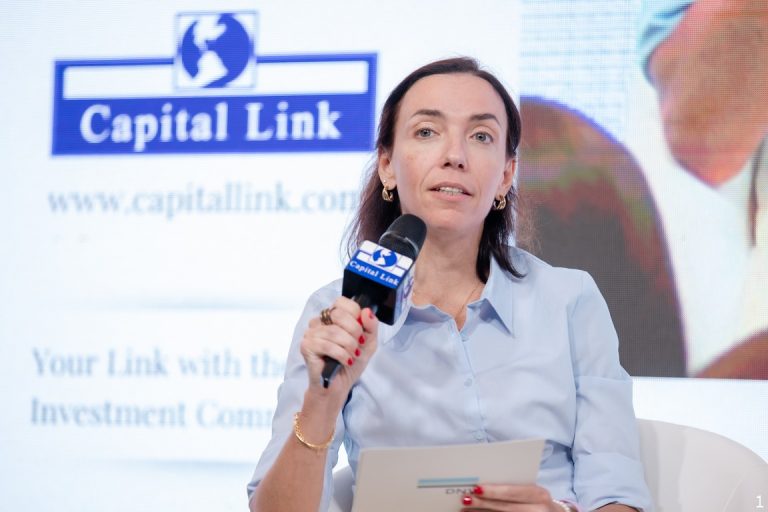
 In this Capital Link Expert Talks episode, Ms. Cristina Saenz de Santa Maria , CEO of DNV Maritime, discussed the evolving maritime landscape and DNV’s strategic direction.
Ms. Saenz de Santa Maria discusses how the pace of change in shipping has accelerated due to geopolitical tensions, particularly the conflict in the Middle East affecting energy security and tonne-mile-driven emissions.
She emphasized that DNV’s key priorities include safety, reliability, independence, and forward-looking solutions, with a focus on pragmatic approaches to help customers navigate urgent challenges.
The conversation covered decarbonization efforts following recent outcomes from MEPC84, where Ms. Saenz de Santa Maria noted the difficulty in reaching consensus on greenhouse gas pricing mechanisms and advised ship owners to build resilience across different regulatory scenarios. Digitalization and AI were highlighted as significant opportunities, though she stressed the importance of responsible implementation and cybersecurity measures.
Ms. Saenz de Santa Maria also discussed the critical role of safety for seafarers, particularly in current challenging contexts, and recommended that companies focus on energy efficiency investments, fleet flexibility, and developing strategies that provide resilience across multiple future scenarios rather than waiting for perfect regulatory clarity.
The full webcast can be viewed here:
Security Emerges as Shipping’s Common Thread
According to Ms. Saenz de Santa Maria, security has become the defining issue connecting many of the challenges confronting the industry. War in the Middle East and disruptions around the Strait of Hormuz were mentioned as a reminder of shipping’s critical role in global energy security and supply chains.
The instability has highlighted how maritime transport supports the movement of energy and commodities worldwide. It has also exposed operational risks for shipowners, crews and cargo interests, Ms. Saenz de Santa Maria noted.
“I would say that an underlying red thread against everything that shipping is going through is that security aspect,” she said.
That concern extends beyond physical operations. Ms. Saenz de Santa Maria warned that the industry’s adoption of digital tools and AI also affects exposure to cyber threats.
“There’s a lot of good things that can be done with those tools, but there’s also the dark side in terms of the cybersecurity part,” she disclosed. DNV’s role, she said, is to provide practical guidance during this period.
“Customers are looking for guidance in those complex times. We try to be pragmatic and help our customers with practical solutions. We focus on safety, reliability, and independence.”
Faster Responses Required
In tandem, with those principles, Ms. Saenz de Santa Maria observed that the operating environment is forcing DNV to rethink how quickly it delivers support and technical advice.
“The pace at which we need to respond to the industry is much higher than what it was required six months ago,” she explained. The urgency is even more evident when customers face disruptions linked to geopolitical events.
She was adamant that “customers that have vessels stuck in the Strait of Hormuz, with their crew there, need solutions today, not in three months.”
That demand for speed applies across all DNV’s activities, from remote surveys and vessel inspections to advice on newbuilding specifications, fuel choices and energy-efficiency investments.
Regulatory Uncertainty Clouds Decarbonization Decisions
The shipping industry continues to pursue its objective of reaching net-zero emissions by 2050, but consensus on how to achieve that goal remains elusive. Reflecting on recent developments, Ms. Saenz de Santa Maria pinpointed that greenhouse-gas pricing mechanisms remain a major point of disagreement.
“The risk of having more regional approaches and legislations will certainly make the shipping context much more complex for the stakeholders and for the ship owners,” she stated.
“We try to advise our customers to start now. Start building resilience and flexibility across different scenarios,” Ms. Saenz de Santa Maria noted, sharing that stability will not be a given in the short term.
In fact, she argued that delaying action until regulators provide complete clarity may prove costly.
“My reflection is that, waiting for full regulatory clarity, is a risk,” she disclosed. Instead of engineering a perfect strategy, she urged companies to move forward with imperfect but actionable plans.
“I think it’s important to have a solution or a plan today, even though it might not be perfect, rather than waiting for the perfect clarity in the years to come,” she reiterated.
AI Creates Opportunity, and Risk
Ms. Saenz de Santa Maria identified artificial intelligence as one of the forces reshaping maritime operations. According to her, recent advances have demonstrated applications and greater potential than many industry participants expected, as it can bring big improvements in terms of performance and efficiency.
At the same time, cybersecurity must become a priority, if this continues to be the case. DNV is already applying AI internally and in customer-facing services. Some areas of focus are route optimization, anomaly detection, survey processes, regulatory support and customer service.
The company has also developed tools like a rules-based AI agent to help users explore standards and technical requirements.
Seafarer Safety
While technology and regulation dominate industry discussions, Ms. Saenz de Santa Maria redirected everyone’s attention towards safety, DNV’s core mission.
The conflict in the Middle East has once again drawn attention to the welfare of seafarers operating under difficult conditions. The industry, she believes, has a responsibility to support crews through better safety measures, connectivity and training.
Nevertheless, Ms. Saenz de Santa Maria advises that companies should avoid betting on a single view of the future. Instead, she impels owners to build resilience through flexibility across their fleets and investment strategies in multiple scenarios.